


In this article
In this article
For organizations running SAP, capital project visibility typically begins once CapEx is approved for the project. Budgets are released, commitments are tracked, and actuals are controlled with precision.
But capital decisions start long before that point and their outcomes extend well beyond it.
Early-stage demand, competing investment options, and business-case assumptions often sit outside SAP, creating gaps in project portfolio management. Likewise, once projects are completed and capitalized, performance outcomes and lessons learned are rarely fed back in a structured way. The result is a fragmented investment lifecycle, where planning, execution, and outcomes are managed in different systems, by different teams, using different data.
While it is technically possible to manage the entire capital lifecycle inside SAP, doing so at scale is rarely practical. Achieving end-to-end CapEx visibility typically requires multiple modules to be configured and consistently adopted, alongside user experiences and licensing models that do not suit infrequent or executive participants. As a result, most organizations rely on Excel, SharePoint, or bespoke tools around SAP, creating visibility gaps rather than closing them.
This blog explores a more pragmatic approach to capital project portfolio visibility. Rather than forcing every process into SAP, leading organizations apply capital project portfolio management to connect planning, approval, forecasting, execution, and outcomes in a way that complements SAP’s strengths, keeps it as the system of record, and avoids unnecessary complexity.
Because true capital project portfolio visibility comes from connecting four views of investment:
- what’s in the hopper,
- what’s approved,
- what’s underway, and
- what’s been achieved.
When these stages are aligned, organizations gain the insight needed to allocate capital with confidence while controlling spend proactively.
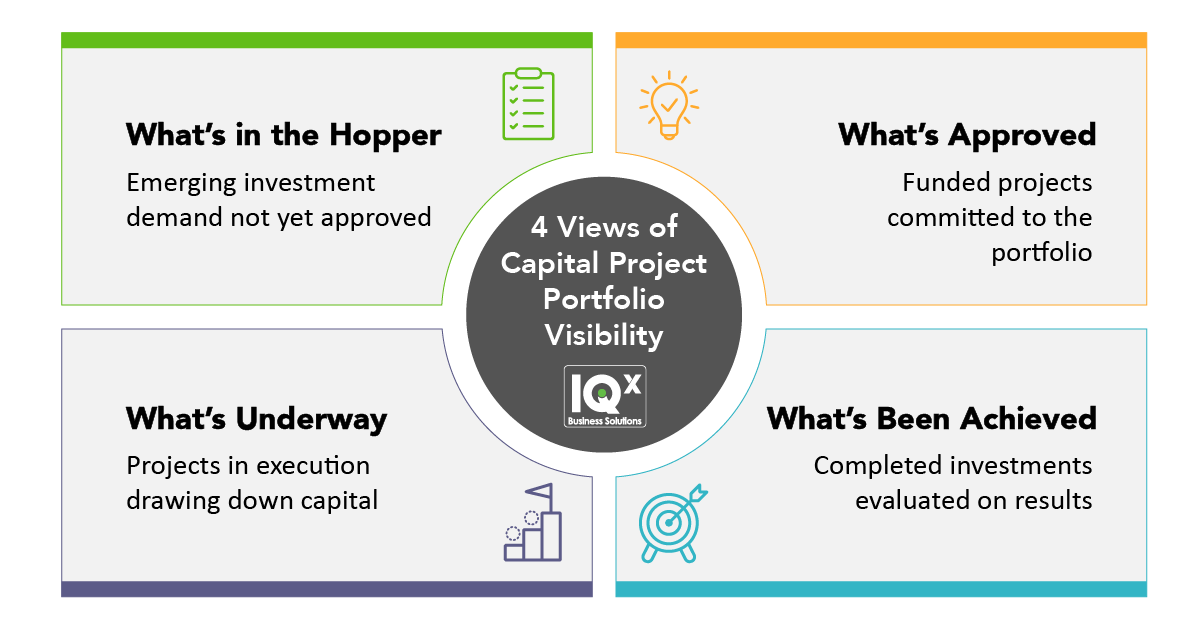
Capital project portfolio visibility is achieved by viewing all stages of investment together as part of a single, connected lifecycle.
The Opportunity Cost of Invisible Capital Misallocation
Without a connected view across the investment lifecycle, organizations lose value in ways that are easy to miss in the moment but difficult to recover later. Capital may appear committed and controlled, yet still be poorly allocated.
Common signs of limited capital visibility include:
- Idle funds locked in delayed or underspent projects, while higher-value initiatives wait for approval or funding
- Overruns identified too late for meaningful corrective action
- Misaligned priorities between regions or business units operating in isolation
- Audit and governance friction caused by manual reconciliation across disconnected reports and systems
These issues are often attributed to process gaps, data quality, or system limitations. In reality, they are visibility gaps that arise between planning, execution, and outcomes. Investment decisions are made upstream of SAP, managed within SAP, and reviewed outside it. Each handover fragments context and weakens the organization’s ability to view the capital portfolio as a single, coherent whole.
The cost of this invisibility is not just financial. It limits the ability to reallocate capital as conditions change, to stop or redirect underperforming investments, and to distinguish between genuine funding constraints and capital that is simply tied up elsewhere.
This is why capital project portfolio visibility is more than a reporting exercise. Connecting all stages of the investment lifecycle enables earlier insight and better decisions before opportunity cost becomes embedded and accepted as business as usual.
Gaining Visibility of Future Demand: What’s in the Hopper?
The first stage of capital project portfolio visibility sits before SAP is engaged.
“What’s in the hopper” covers early-stage project ideas, CapEx business cases, and investment requests that have not yet been created as SAP execution objects such as Internal Orders or Work Breakdown Structures. At this stage, scope and costs are indicative and priorities are still forming.
For SAP-run organizations, this stage has an outsized influence on what follows. The quality and comparability of capital data inside SAP are shaped upstream. How initiatives are defined, costed, categorized, and prioritized before they enter the system determines how cleanly they transition into execution and how reliably future demand can be assessed.
Where Visibility Breaks Down
In many SAP environments, early-stage capital demand is managed in Excel, SharePoint, or similar tools. While familiar and flexible, these approaches rarely enforce consistent cost structures, naming conventions, or categorization.
As a result, proposals are often defined in ways that do not align cleanly to SAP master data. Once initiatives are approved, linking them back to cost centers, company codes, or asset classes requires manual interpretation and rework, often under time pressure.
This fragmentation also limits portfolio-level visibility. Without a consolidated pipeline across divisions or business units, organizations struggle to forecast upcoming cashflow and capital requirements or identify emerging budget pressure. Decisions are made in isolation, rather than with visibility of competing initiatives across the enterprise.
Creating A Structured Intake Process
Organizations that improve visibility at this stage do not attempt to manage all early-stage capital demand directly in SAP. Instead, they introduce a structured intake process outside SAP, designed to align with SAP data models and execution structures from the outset.
Early-stage proposals are defined using fields that mirror SAP master data including investment category, responsible cost center, company code, and asset class, allowing approved initiatives to be created directly as Internal Orders (CO) or Work Breakdown Structures (PS) without rework.
Proposals are assessed using consistent evaluation criteria, enabling like-for-like comparison and prioritization through structured Appropriation Requests that support clear scoring, ranking and funding decision.
While SAP Portfolio and Project Management (PPM) and Investment Management (IM) can support the identification of potential initiatives, they are rarely used as the primary source of demand. In practice, approvals often occur outside SAP and are only formalized once funding is confirmed.
To avoid loss of context at this handover point, leading organizations establish a governance bridge between early evaluation and SAP execution ensuring that ROI assumptions, risk profiles, and payback expectations remain visible and traceable as projects move into execution and reporting.
What This Enables Across the Portfolio
With future demand captured in a consistent, SAP-aligned way, organizations can see capital pressure before budgets are released. Finance and planning teams can anticipate funding requirements, compare competing initiatives, and understand how emerging demand will affect portfolio capacity over time.
When projects are approved, they transition into SAP with minimal rework and clear lineage back to their original intent. This preserves SAP’s role as the system of financial record, while improving confidence in portfolio-level forecasts and prioritization decisions.
Capital Project Portfolio Management – Aligning Approved Projects with Strategic Intent
Once project demand has been consistently captured and evaluated, the objective of capital project portfolio management is to select the projects that matter most, within available financial capacity and human resource constraints.
In many organizations, this selection process is manual, disconnected, and time-consuming. Portfolio decisions are therefore made infrequently, often as part of an annual planning or budgeting cycle. In a dynamic operating environment, this creates risk. Investment needs evolve, projects are delayed, and funding capacity shifts as economic and operational conditions change. Yet portfolios are often treated as static once approved.
Where the end-to-end CapEx process is effectively digitized, this constraint is reduced. New initiatives can be introduced as they emerge, changes in capacity can be identified as projects progress or stall, and portfolio decisions can be revisited as conditions change, rather than deferred to the next planning cycle.
Within SAP, portfolio visibility typically begins once projects are approved. At that point, initiatives are created as Internal Orders (CO) or Work Breakdown Structures (PS), and SAP continues its role as the financial system of record for capital budgets, releases, and expenditure tracking. Financial control is strong, but visibility is largely limited to the approved portfolio.
This creates a natural boundary between portfolio selection and portfolio execution. A boundary that must be carefully managed to ensure approved investments remain aligned with strategic intent.
Optimizing SAP Project Portfolio Management (PPM)
Once projects are approved, portfolio optimization depends on how effectively the approved portfolio is reviewed over time.
To optimize SAP PPM, organizations need a comparative view that considers approved projects in the context of both execution status and competing demand. Specifically, this requires combining:
- the current status of in-progress projects (timing, spend profile, remaining forecast), and
- the backlog of proposed initiatives competing for the same capital and capacity.
This enables three critical portfolio decisions:
- Identify available budget capacity created by project expenditure delays, underspend, or rephasing
- Reassess the relative value of in-flight projects against backlog initiatives, enabling executives to stop or redirect funding (even for projects that are on track) when higher-value opportunities emerge.
- Evaluate project supplements with reference to the original and updated business case, alongside alternative investments
Without this comparative view, portfolio governance tends to default to managing what has already been approved. With it, the portfolio can be actively re-determined as conditions evolve.
Why Approved Portfolios Drift Out of Alignment
At this stage, the challenge is no longer demand capture, it is maintaining comparability and intent as projects move through execution.
In many organizations, portfolio views must be assembled across multiple SAP instances, company codes, and planning artefacts. Manual consolidation of budgets, approvals, and releases is required, limiting portfolio consistency and increases reliance on point-in-time reporting.
As a result, portfolio-level questions become difficult to answer:
- How balanced is current investment across growth, sustenance, and compliance?
- How does the timing of capital releases compare across projects?
- Where is funding genuinely constrained versus temporarily unavailable?
At the same time, business-case intent weakens once projects enter SAP execution. Internal Orders and WBS structures track cost and progress accurately, but objectives, expected benefits, and risk assumptions are rarely carried forward in a way that supports ongoing portfolio evaluation.
The portfolio remains financially controlled but progressively harder to assess against strategic intent.
Creating Alignment Across the Approved Portfolio
Organizations that manage this stage effectively focus on integrating portfolio decision-making with execution reality, rather than treating approval, delivery, and review as separate activities.
This typically requires a consistent front-end planning layer, deeply integrated with SAP, to create project structures and continuously retrieve commitments and incurred costs from execution objects. Platforms such as Stratex Online enable this connection by aligning portfolio logic with SAP Investment Management, Project Systems, and Controlling data.
With this foundation in place, approved investments are regularly re-evaluated, particularly when supplementary funding is requested. In-flight projects are assessed relative to the next best alternative in the backlog, allowing capital to be redirected when better returns are available, rather than progressing by default.
Structural consistency also matters. Harmonized WBS hierarchies, Investment Program levels, and status codes across entities allow portfolios to be compared meaningfully. Aligning budget release logic such as annual versus stage-gate release, further improves comparability and timing analysis.
Crucially, approved projects retain a clear link to their business-case metadata, including objectives, expected benefits, and risk profile. Portfolio reviews are no longer limited to spend and progress; they combine SAP transactional data with strategic performance indicators through periodic portfolio health checks.
The result is not tighter control, but better alignment where approved projects remain comparable, reviewable, and strategically coherent as conditions change.
A Portfolio that Remains Aligned Over Time
When approved projects are managed as a connected portfolio, the SAP landscape supports both financial control and strategic decision-making.
SAP ensures approved capital is controlled and reported correctly. Portfolio visibility ensures that capital continues to be allocated to the most valuable investments as priorities, timing, and expected returns change.
The approved SAP portfolio remains transparent, auditable, and comparable across projects, business units, and time periods. Budgets, releases, commitments, and actuals are governed consistently, while portfolio-level reviews retain visibility of strategic intent and performance expectations.
This creates a single source of truth for ongoing governance and performance assessment, where SAP continues to provide authoritative financial data, and portfolio decisions can be revisited with confidence as conditions change.
Currently in Progress – Connecting Execution to the Business Case
Once projects move into execution, the focus shifts from portfolio selection to delivery and performance.
In SAP environments, approved capital projects are typically managed through Internal Orders (CO) for smaller or one-off initiatives, and Work Breakdown Structures (WBS) within Project System (PS) for larger or more complex programs. These execution structures integrate with Procurement (MM) and Asset Accounting (AA), providing strong financial control over commitments, actuals, and capitalization.
While SAP provides accurate transactional data, translating execution figures into delivery insight remains a common challenge. Financial results are visible, but what they mean for progress, timing, and value delivery is often unclear during execution, when decisions still matter.
When Execution Data Loses Its Decision Context
During delivery, projects are usually well controlled financially but weakly connected to the outcomes they were approved to deliver.
Delays and cost overruns are visible in SAP once they occur, yet their impact on expected returns and strategic objectives is rarely assessed in real time. As a result, many CapEx projects are managed against cost, schedule, and scope, while the business case (expected savings, revenue, or risk reduction) sits outside the execution view. As a result, decisions that could improve overall value, such as accelerating delivery or selectively increasing spend to realize benefits sooner, are often deprioritized.
Forecasting discipline further limits visibility. Execution forecasts are not always updated or versioned consistently, making it difficult to distinguish between original plan, revised expectations, and actual performance. Variances are presented after they materialize, reducing the opportunity for corrective action.
Execution insight is also fragmented across functions. Finance, Engineering, and Procurement operate from different SAP views; commitments, actuals, progress, and vendor activity often reviewed on different cadences. Without a shared execution narrative, issues are identified retrospectively rather than anticipated.
The result is not a lack of data, but a lack of decision-ready insight during delivery.
Turning Execution Data into Performance Insight
Leading organizations treat execution data as an input to decision-making rather than a record of spend.
Project execution metrics are assessed alongside updated expectations of impact, so cost and schedule are reviewed in terms of what they mean for benefits realization, timing, and value delivery.
This requires discipline in forecasting. Execution forecasts are regularly updated and versioned, clearly separating original plan, reforecast, and actual. Changes in expectations are explicit, enabling earlier intervention.
Operational cadence is aligned across functions. Finance, Engineering, and Procurement review commitments, actuals, progress, and vendor activity against a common time horizon, creating a single execution view rather than parallel interpretations.
With this structure in place, organizations can track how delivery changes affect expected outcomes and identify underspend early, allowing capital to be reallocated to higher-priority work while corrective action is still possible.
From Financial Tracking to Execution Intelligence
When execution data remains connected to business-case intent, SAP execution objects become more than a record of cost.
Actuals, commitments, forecasts, and progress need to be viewed together as CapEx KPIs that explain beyond spend, to what it means for delivery, timing, and value realization. Variances are understood in context, enabling decisions while outcomes can still be influenced.
Execution management shifts from retrospective reporting to timely, evidence-based decision-making, where delivery performance and business outcomes remain connected throughout the project lifecycle.
Outcomes of What’s Done and Closing the Loop
Once capital projects are complete and capitalized, their financial lifecycle in SAP is effectively closed.
Whether managed through Internal Orders (CO) or Project System (PS), costs are settled to Assets Under Construction (AUCs) or finalized fixed assets in Asset Accounting (AA), depreciation begins, and the project is marked as financially complete. From an SAP perspective, this is the end point.
What typically does not follow is a structured view of outcomes.
While SAP confirms that capital has been spent and capitalized correctly, insight into whether the investment delivered its intended value is rarely captured in-system. Performance outcomes and delivery insights are usually reviewed manually or outside SAP, if they are reviewed at all. As a result, knowledge gained during execution is seldom carried forward into future demand, portfolio decisions, or project planning.
When Completion Becomes a Blind Spot
After financial completion, many organizations lose visibility into whether capital investments actually delivered value.
There is typically no consistent feedback loop linking realized outcomes (such as efficiency gains, revenue uplift, or cost savings) back to the original business case. Once costs are capitalized, the connection between what was approved and what was achieved weakens rapidly.
Lessons learned during delivery are rarely captured in a structured or reusable way. Insights about scope decisions, delivery approaches, vendor performance, or risk assumptions remain informal, dispersed, or lost altogether.
As a result, completed projects are treated primarily as financial assets, tracked through depreciation and asset values, rather than as investments whose performance can be evaluated. The organization moves on financially, but not informationally and the next investment cycle begins without the benefit of evidence from the last one.
Turning Completed Projects into Organizational Intelligence
Organizations that close the loop treat project completion as the start of learning, not the end of reporting.
This begins with structured post-completion reviews that compare actual cost, delivery performance, and realized benefits against the approved business case. The objective is not to re-litigate execution decisions, but to establish an evidence-based view of what was delivered relative to expectations.
Key performance measures (such as cost variance, delivery variance, and benefit realization) are retained in a central, reusable form, rather than buried in project artefacts. Over time, this grounds future estimates, forecasts, and assumptions in observed outcomes.
Crucially, these insights are fed back into early-stage evaluation and prioritization frameworks. Screening criteria, ranking models, and forecasting assumptions improve with each completed project, strengthening decision quality upstream.
Maintaining traceability between completed assets and their originating business cases ensures outcomes can be reviewed in context, supporting governance, audit readiness, and performance reporting. Capital investments are no longer assessed solely on whether they were capitalized correctly, but on whether they delivered the value they were approved to achieve.
From Financial Completion to Portfolio Foresight
When outcomes are deliberately captured and reviewed, financial completion in SAP becomes more than an accounting milestone.
Each completed project contributes evidence, about cost accuracy, delivery performance, and realized value, that informs future investment decisions. Lessons accumulate, assumptions are refined, and business cases become progressively stronger.
Closing the loop transforms capital delivery from a series of isolated projects into a continuous learning cycle, where SAP’s financial completeness supports organizational foresight and more confident capital planning over time.
Where SAP Data Lives and Where Connected Planning Begins
| Lifecycle Stage | SAP’s Role | Visibility Gap | Connected Planning Layer Role |
|---|---|---|---|
| What’s in the Hopper | No WBS/IO yet; SAP not engaged. | No structured intake or link to master data. | Centralizes idea capture and scoring; prepares SAP-ready structures. |
| Current Portfolio | Tracks budgets, approvals, and funding limits. | Limited visibility into strategic alignment or justification. | Adds portfolio-level analysis and capital balance context. |
| In Progress | Records commitments, actuals, and forecasts. | Impact of delays and over-runs on the anticipated business value. | Enables rolling forecasts and updated impact analysis for changes in estimating assumptions (BOTH costs and returns) |
| Outcomes | Records capitalization and depreciation. | No feedback loop to planning. | Feeds completion metrics into future evaluation and planning. |
The Enterprise View: Governance and Trust in SAP Data
At enterprise scale, portfolio visibility breaks down because SAP data is governed differently across the organization.
Even where SAP provides accurate financial data at a project or regional level, inconsistencies in how capital data is defined and reported quickly undermine confidence in portfolio insight. Visibility built on inconsistent data leads to manual reconciliation, delayed decisions, and reliance on offline reporting.
This section shifts the focus from individual projects and portfolios to the enterprise layer where shared definitions, cadence, and accountability determine whether SAP data can be trusted for organization-wide capital decisions.
The Reality of Multi-Instance SAP Environments
In most large organizations, capital data does not sit within a single, uniform SAP landscape.
Multiple SAP instances: often a mix of ECC and S/4HANA, regional rollouts, and legacy acquisitions, operate with different company codes, charts of accounts, project types, and approval models. Each environment is usually well governed locally and optimized for regional requirements.
The challenge emerges when these environments are viewed together.
When project hierarchies, status definitions, cost categories, or asset classifications vary by region, SAP produces multiple versions of “correct” data. Local reporting remains accurate, but enterprise portfolio views require interpretation and adjustment. Over time, this creates local truth without global CapEx visibility because the data is not comparable.
Governance as the Enabler of Trusted Visibility
At enterprise scale, visibility is created through governance discipline, not additional reporting layers.
Effective governance focuses on standardizing a small set of core capital data elements across all SAP entities, including project type, organizational accountability, stakeholder responsibilities, project stage, cost and benefit categorization and phasing. When these elements are consistent, portfolio data becomes comparable by design rather than through reconciliation.
Governance also requires alignment on reporting cadence and definitions. Terms such as “Approved,” “Released,” or “Closed” must mean the same thing in every system, and data must be assessed against a common point in time. Enterprise foreign currency translation and calendar rules further prevent timing distortions when consolidating capital data across regions.
Finally, governance must be owned. Many organizations assign responsibility to a Capital PMO or finance-led stewardship function to define standards, validate compliance, and manage exceptions. Execution remains decentralized, but trust becomes centralized.
Together, these controls elevate SAP data from locally accurate information to enterprise-grade portfolio insight.
SAP’s Role in an Enterprise Visibility Model
In this ecosystem, SAP provides financial truth, but not enterprise consistency by default.
SAP reliably records budgets, commitments, actuals, and capitalization at the transactional level. However, consistency across business units and regions only emerges when governance is applied deliberately.
Enterprise reporting tools such as SAP Analytics Cloud consolidate financial data into portfolio views. Their effectiveness depends on consistent structures, definitions, and timing; without governance, consolidation becomes reconciliation.
A connected planning layer complements this model by enforcing structure and synchronization before data reaches SAP and central reporting. It aligns how capital data is captured and reviewed across local systems, ensuring enterprise reporting reflects comparable, decision-ready information.
Together, SAP, enterprise reporting, and a connected planning layer form a coherent visibility model where financial accuracy, structural consistency, and governance reinforce one another.
The People Side of Visibility
Even when SAP data is accurate, portfolio visibility depends on how people update, interpret, and act on that information. Visibility gaps often emerge from misaligned roles, timing, and ownership.
How Different Teams Interact with SAP
- Finance focuses on budgets, approvals, releases, and financial control
- Engineering updates progress, milestones, and completion status
- Procurement manages commitments, contracts, and vendor spend
Each view is valid, but incomplete on its own.
Where Visibility Breaks Down
- Teams operate on different cadences (monthly close vs weekly progress vs real-time purchasing)
- Updates are technically accurate but out of sync
- Assumptions change, but no one is clearly accountable for revisiting them
- Issues surface late because signals are fragmented across functions
The result is reactive reporting and delayed portfolio decisions, rather than a shared, decision-ready view of capital performance.
What Improves Decision Confidence
- Clear ownership of forecast updates and status changes
- Defined responsibility for signaling readiness for closure
- Explicit accountability for revisiting assumptions when conditions change
- Regular cross-functional reviews that align financial, operational, and commercial perspectives
When stewardship, ownership, and cadence are clear, SAP becomes a shared, decision-ready view of performance, shifting conversations from reconciling data to making portfolio decisions.
Looking Ahead – From Visibility to Foresight
When capital and project data can be relied upon, visibility moves beyond reporting and becomes a basis for forward-looking decision-making. With a connected planning layer, organizations are no longer limited to explaining past outcomes. Instead, they can anticipate how today’s portfolio decisions are likely to play out.
In mature SAP environments, this enables a shift from static oversight to active portfolio management:
- Identify patterns in forecast accuracy, delivery delays, and budget utilization across regions, company codes, or asset classes
- Assess cash-flow timing and portfolio risk using SAP actuals and commitments as a consistent baseline
- Surface emerging risk early, using predictive analytics or AI to highlight projects trending toward overspend, delay, or under-delivery before period end
- Evaluate portfolio scenarios, combining SAP historical data with planning-layer assumptions to understand how reprioritization, deferral, or acceleration affects liquidity and return on investment
The result is a more proactive capital management environment. SAP continues to provide trusted financial data, while connected analytics and planning capabilities turn that data into early signals and clearer trade-offs.
This is where portfolio visibility stops being retrospective and starts informing what happens next.
Conclusion: Capital Project Portfolio Visibility as a Discipline
Capital project portfolio visibility is not a feature that can be switched on in SAP. It is a discipline built through connection, consistency, and shared accountability across systems, data, and teams.
Full visibility does not require every activity to run inside SAP. It requires alignment around SAP. Planning, forecasting, execution, and performance feedback must share a common structure, language, and cadence so that information moves cleanly across the investment lifecycle.
In this model, SAP continues to do what it does best: provide accurate, auditable financial control. A connected planning layer complements that strength by linking business intent to project execution and realized outcomes; ensuring context is not lost as investments move from idea to approval, delivery, and completion.
Organizations that master this connection gain both governance and agility. Financial truth is preserved, while decision-makers gain the foresight to reallocate capital, manage risk, and act early.
When project portfolio visibility is treated as a process, SAP evolves from a record of what happened into a foundation for what comes next, enabling confident, strategic, and data-driven capital investment decisions across the enterprise.
FAQs on Capital Project Portfolio Visibility
Related Posts
If you enjoyed reading this, then please explore our other articles below:


