


In this article
- 1. What Is Fixed Asset Management in SAP?
- 2. The Core Processes of Managing Fixed Assets in SAP
- 3. Why SAP Alone Can’t Solve These Challenges
- 4. Managing Fixed Assets with a Usable, Workflow-Driven, SAP-Centric Layer
- 5. Bringing Finance & Engineering Together
- The Path to a Modern, Risk-Resilient Asset Management Approach
- FAQs on Managing Fixed Assets in SAP
In this article
- 1. What Is Fixed Asset Management in SAP?
- 2. The Core Processes of Managing Fixed Assets in SAP
- 3. Why SAP Alone Can’t Solve These Challenges
- 4. Managing Fixed Assets with a Usable, Workflow-Driven, SAP-Centric Layer
- 5. Bringing Finance & Engineering Together
- The Path to a Modern, Risk-Resilient Asset Management Approach
- FAQs on Managing Fixed Assets in SAP
Fixed assets represent some of the largest and longest-lived investments organizations manage in SAP. From production equipment and infrastructure to vehicles and facilities, these assets underpin both day-to-day operations and long-term capital outcomes.
Despite this, many organizations struggle to answer basic questions about their fixed assets with confidence. Where are they? Who owns them today? Are they still in use? Are the values correct? And can the asset register be relied on when decisions and audits matter?
In most cases, the issue isn’t missing data. It’s how asset information degrades as assets move through their lifecycle.
As fixed assets are built, commissioned, transferred, modified, verified, and eventually retired, responsibility shifts between teams, projects, engineering, operations, finance, and audit. Each handover introduces friction. Over time, these small gaps compound creating disconnects between SAP’s financial view of the asset and the physical reality of assets on the ground.
These gaps don’t just create administrative inefficiency. They erode confidence in asset information, complicate audits, increase risk, and make everyday decisions harder than they should be.
This blog explores how organizations approach the challenge of managing fixed assets across the full SAP asset lifecycle. It examines where breakdowns commonly occur, why they persist even in mature SAP environments, and what it takes to maintain a connected, reliable view of fixed assets as they move from creation through to retirement.
1. What Is Fixed Asset Management in SAP?
Fixed asset management in SAP refers to how organizations record, control, and govern physical assets using SAP as the financial system of record. The goal is to ensure asset values, ownership, and lifecycle events are accurately captured to support financial reporting, compliance, and decision-making.
At the core of SAP’s approach is Fixed Asset Accounting (FI-AA), which supports the financial and statutory aspects of managing fixed assets, including:
- Capitalization of assets
- Depreciation over useful life
- Valuation and impairment
- Retirement and disposal
From a system perspective, fixed assets are primarily managed through a finance and accounting lens, focused on value, useful life, cost allocation, and reporting requirements.
In practice, however, managing fixed assets extends well beyond finance. The same asset is touched by multiple functions at different stages of its life, including:
- Projects and Assets Under Construction (AUC)
- Engineering and technical teams
- Operations and site-based users
- Procurement and supply chain
- Audit, risk, and compliance teams
As assets progress through their lifecycle, responsibility and context shift. An asset may be created through a project, modified by engineering, operated in the field, transferred between business units, verified onsite, and eventually retired.
For this reason, managing fixed assets in SAP is inherently cross-functional. It depends on coordination between financial records and operational activity, and alignment between the teams that create, use, maintain, and account for assets.
2. The Core Processes of Managing Fixed Assets in SAP
Managing fixed assets in SAP centers around a set of core processes that every organization must govern across the asset lifecycle. The diagram below illustrates the key processes that form the foundation of day-to-day asset management:
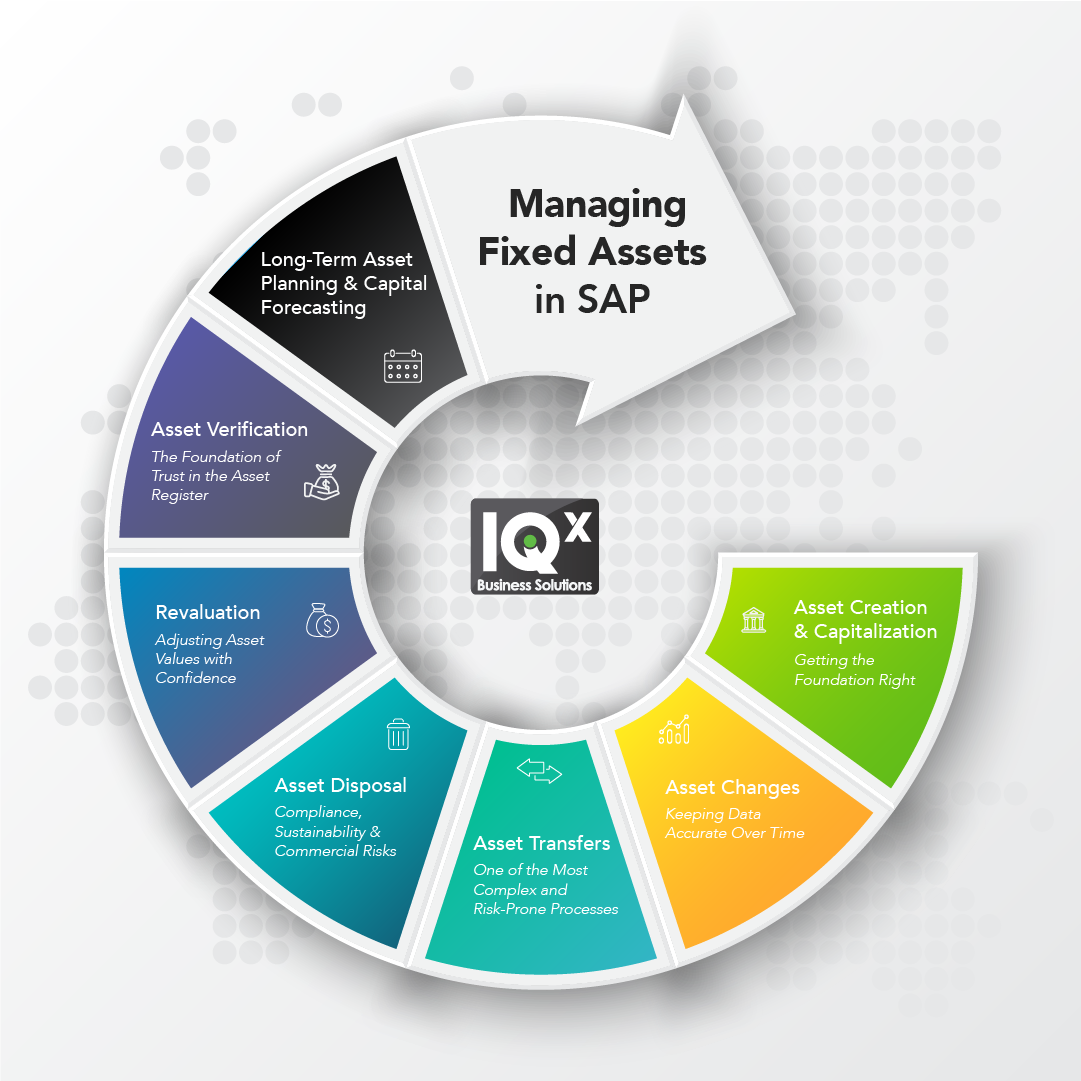
These processes represent how assets are introduced, updated, moved, valued, verified and retired within SAP. While SAP records the financial postings, organizations must define the workflows, approvals, roles, and cross-functional inputs that make these processes reliable and compliant.
2.1 Asset Creation & Capitalization: Getting the Foundation Right
Asset creation and capitalization define how an investment first enters the fixed asset register in SAP. At this stage, core asset attributes such as master data, capitalization timing, and depreciation settings are established.
Common challenges include:
- Different interpretations of when an asset is ready to be capitalized
- Incomplete or inconsistent information from engineering, vendors, or site teams
- Confusion between manufacturer and supplier details, resulting in mismatched identifiers
- Missing or incorrect asset tags, or no linkage to related equipment
- Depreciation setup complexities, including useful life, cost center allocation, or parallel depreciation
- Assets built or commissioned in stages, complicating capitalization decisions
- Application of accounting rules around valuation and componentization
Because these decisions form the baseline of the asset record, they shape how the asset is treated in later processes such as depreciation, transfers, verification, revaluation, and disposal.
Assets Under Construction (AUC)
Assets Under Construction (AUC) are used to capture capital spend before an asset meets the criteria for capitalization. They are commonly associated with project-based builds and staged commissioning activities.
Typical challenges include:
- Lack of clarity on when an AUC should be settled and capitalized
- Inconsistent settlement from WBS elements or internal orders to AUCs or final assets
- Project completion being declared before sufficient financial evidence is available
- Partial or phased operational commissioning that does not align cleanly with asset structures and SAP cost structures
- Delays in capitalization that affect depreciation timing and reporting
How AUCs are managed influences the accuracy, timing, and classification of assets as they transition into the fixed asset register and progress through subsequent lifecycle stages.
2.2 Asset Changes: Keeping Data Accurate Over Time
Once capitalized, fixed assets continue to change over time. Upgrades, relocations, reconfigurations, and ownership shifts all require updates to the asset record in SAP.
These changes are often incremental and initiated outside finance, making them easy to miss or inconsistently applied in SAP.
Common challenges include:
- Deciding whether a partial upgrade should be treated as a new asset or an improvement
- Departmental or cost center ownership changes that are not reflected in SAP
- Useful life or classification changes driven by engineering but not updated in finance
- Sub-asset and component structures that are not maintained as assets evolve
- Change information that does not align with SAP terminology or structures
- Keeping asset records aligned when equipment configurations change
When asset changes are not captured consistently, discrepancies between operational reality and financial records tend to build over time, affecting depreciation, reporting, and audit confidence.
2.3 Asset Transfers: One of the Most Complex and Risk-Prone Processes
Asset transfers move fixed assets between locations, cost centers, business units, or legal entities in SAP. While the transaction itself is simple, the surrounding rules and approvals often are not.
Different requirements apply depending on whether a transfer is intracompany or intercompany, bringing tax, valuation, and posting considerations into play. Transfers also typically involve multiple teams on both the sending and receiving side.
Common challenges include:
- Difficulty identifying surplus or under-utilized assets
- Intercompany versus intracompany transfer rules with different tax and posting treatments
- Fair value versus book value disagreements
- Long approval chains across multiple business units
- Bulk transfers of spares, rotables, or grouped equipment with mixed values or ownership
- Non-finance users struggling to select or validate the correct assets
- Lack of structured workflow, leading to reliance on emails, spreadsheets, and manual coordination
Because transfers affect ownership, valuation, depreciation, tax, and audit trails, limited visibility or control at this stage can introduce risk that carries forward into subsequent asset processes.
2.4 Asset Disposal: Compliance, Sustainability & Commercial Risks
Asset disposal marks the point where an asset is removed from active use and retired in SAP. While SAP records the retirement posting, asset disposal in practice involves a broader set of activities that extend beyond the financial transaction.
Common challenges include:
- Lack of structured disposal workflows, with SAP capturing the entry but not the process
- Environmental and sustainability requirements such as e-waste recycling, metal recovery, or vehicle deregistration
- Commercial disposal steps, including asset sales, revenue recognition, and GST treatment
- Preventing misappropriation where assets are written off with little or no recoverable value
- Missing or incomplete documentation, including scrap certificates, deregistration letters, insurance cancellation, or tag removal
- Physical disposal occurring without the corresponding asset being retired in SAP, or vice versa
Because disposal affects compliance, audit trails, sustainability reporting, and financial integrity, inconsistencies at this stage can weaken confidence in the fixed asset register.
2.5 Revaluation – Adjusting Asset Values with Confidence
Asset revaluation involves updating the recorded value of fixed assets in SAP to reflect changes in condition, usage, market value, or accounting requirements. Revaluations may apply to individual assets or entire asset classes and often require input beyond finance.
Common challenges include:
- Determining when a revaluation is required versus when a change is operational only
- Ensuring upward and downward revaluations comply with applicable accounting standards
- Incorporating condition or usage information from engineering to support valuation decisions
- Reconciling insurance values with accounting values
- Providing sufficient audit evidence to support revaluation entries
- Executing revaluations consistently across asset classes
- Ensuring depreciation is recalculated correctly following revaluation
Because revaluations affect asset values, depreciation, statutory reporting, tax, and insurance, inconsistencies or gaps at this stage can have broad downstream implications.
2.6 Asset Verification: The Foundation of Trust in the Asset Register
Fixed asset verification is the process of confirming that fixed assets recorded in SAP physically exist, are correctly identified, and are located where the register says they are. It is typically performed as part of audit preparation, compliance activities, insurance reviews, or periodic asset counts.
In many organizations, verification remains one of the most manual stages of the fixed asset lifecycle.
Common challenges include:
- Verification activities that rely on paper lists or spreadsheets
- Difficulty locating assets on site or confirming their current location
- Asset identity being unclear due to missing, damaged, or faded tags
- Finance working with fixed asset records while engineering works with equipment records, using different identifiers
- Fixed assets and equipment records not being linked
- Limited supporting evidence such as photos, condition notes, or precise location data
- Lack of mobile tools, resulting in information being captured offline and re-entered later
- Missed opportunities to improve accuracy through mobile capture, tagging upgrades, or assisted identification
Because verification is where recorded asset data is tested against physical reality, gaps at this stage often surface discrepancies that have accumulated across earlier processes, affecting audit confidence, insurance accuracy, and long-term asset planning.
2.7 Long-Term Asset Planning & Capital Forecasting
Long-term asset planning and capital forecasting extend fixed asset management beyond day-to-day control into future investment decisions. They rely on understanding when assets are likely to require replacement, refurbishment, or major upgrade and how those needs translate into capital demand over time.
In many organizations, this is where financial data in SAP and operational insight diverge.
Common challenges include:
- Finance and engineering working from different information sets, with limited alignment between financial data and asset condition, performance, or risk
- Lack of structured approaches to modelling asset replacement timing, leading to reactive decisions
- Heavy reliance on asset age as a proxy for condition due to limited integration of operational data
- Difficulty producing a confident multi-year view of future capital requirements
- SAP providing financial accuracy without the broader context needed for lifecycle costing or long-term planning
- Long-range forecasts being built in spreadsheets that are hard to maintain or carry forward year to year
As a result, long-term planning often depends on fragmented inputs and assumptions, making it harder to anticipate capital needs, compare investment options, or allocate budgets with confidence across future periods.
3. Why SAP Alone Can’t Solve These Challenges
SAP plays a central role in fixed asset management by recording financial entries and supporting statutory reporting. It is where asset values are posted and maintained.
However, many of the challenges organizations experience with fixed assets sit outside the transaction itself. Across the asset lifecycle, finance is responsible for controlling outcomes — but the decisions that lead to those outcomes rely on approvals, evidence, coordination, and usability that SAP does not natively define.
This becomes clear when comparing what finance needs to govern at each lifecycle stage with what SAP provides out of the box.
| Lifecycle Stage | What Finance Needs to Control | Where SAP Stops Short |
|---|---|---|
| Create | Accurate master data, correct capitalization timing, project/WBS alignment | Posts the asset, but no workflow, no guided steps, limited validation, no automatic equipment link |
| Change | Ownership, cost center, useful-life, sub-asset structure, classification | Allows field changes but no approvals, weak governance, no tie-in to equipment changes |
| Transfer | Intercompany vs intracompany rules, transfer pricing, multi-party approvals | Provides a transaction only; no workflow, no bulk support, poor visibility for engineers |
| Revalue | Policy compliance, valuation inputs, documentation, insurance alignment | Posts the entry but doesn’t help with calculations, evidence, or governance |
| Verify | Physical existence, location, condition, discrepancies, audit evidence | No mobile tools, no photos, no condition capture, no asset-equipment reconciliation |
| Dispose | Approvals, commercial recovery, sustainable disposal, deregistration | Posts the retirement only; no support for process, documentation, or compliance steps |
Across creation, changes, transfers, revaluation, verification, and disposal, the pattern is consistent. SAP supports the posting of the transaction, but not the surrounding process that determines whether the transaction is correct, complete, or compliant.
As a result, much of the work required to manage fixed assets happens outside SAP. Common approaches include:
- Spreadsheets to track approvals, values, or asset movements
- Email chains to coordinate decisions and sign-offs
- PDFs or shared folders to store supporting documentation
- Manual approval steps and offline checks
- Reliance on individual knowledge held by finance, engineering, or site teams
Over time, these workarounds become embedded in day-to-day operations.
Across organizations, the same structural gaps tend to recur:
- No consistent workflow defining approvals and sequencing
- Limited visibility into approval status or decision history
- Poor usability for non-finance users
- Limited support for bulk or site-based activities
- Difficulty identifying or locating assets at scale
- No native connection between fixed asset and equipment records
- Minimal support for onsite tasks such as verification or disposal evidence
SAP remains essential as the financial foundation. But it does not model the end-to-end business processes organizations rely on to manage fixed assets in practice.
4. Managing Fixed Assets with a Usable, Workflow-Driven, SAP-Centric Layer
Organizations that manage fixed assets effectively do not replace SAP. They focus instead on how people actually work with SAP to address fixed asset accounting challenges in practice.
SAP remains the system of record for financial postings and statutory reporting. The challenge is how asset decisions; approvals, evidence capture, coordination, and data accuracy are supported before and after transactions are posted.
A modern approach acknowledges these challenges and adds a layer around SAP that improves usability, workflow, and visibility for everyone involved. This principle-based layer supports fixed asset processes without changing SAP’s role or data integrity.
4.1 Fiori as the Enablement Layer — Not a Replacement
SAP remains the single source of truth for fixed asset accounting. What changes is how people interact with it.
SAP Fiori acts as an enablement layer that makes SAP accessible to the teams involved in fixed asset processes, not just finance. It surfaces the right information to the right people, in a format aligned to how they work, and supports the steps that lead up to a transaction being posted.
This includes guiding users through processes SAP does not natively define, such as approvals, evidence capture, and cross-functional coordination, while leaving the underlying accounting logic untouched.
This is not about “fixing SAP.” It is about giving the business a practical way to work with SAP.
4.2 Making Fixed-Asset Transactions Easy & Controlled
This is where organizations see the biggest improvement in internal control and auditability.
When fixed-asset transactions are easy to execute correctly, control is built into the process rather than enforced through manual checks. Usability and governance work together, reducing reliance on emails, spreadsheets, and after-the-fact review.
A modern approach focuses on making transactions clear and consistent within SAP, so users can complete asset activities with confidence.
Key principles include:
- Intuitive asset search to quickly find the right assets
- Clear approval routing instead of email chains
- Guided steps to ensure consistent data capture
- Role-based views tailored to different users
- A single interface for all fixed-asset activities
Designed this way, fixed-asset transactions become easier to manage and easier to audit without adding complexity to the accounting layer.
4.3 Mobility for Verification & Real-World Work
Mobility closes the gap between the physical world and the SAP world.
Most fixed-asset work happens in the field, not at a desk. When asset processes are tied to desktop systems, teams are forced to capture information later, increasing the risk of errors and omissions.
A mobile-first approach brings asset activities to where the assets actually are. Key principles include:
- Mobile scanning to identify assets accurately on site
- Photos and location capture to support verification and audit evidence
- Real-time condition assessment while assets are being inspected
- Onsite capture of disposal evidence, rather than retrospective documentation
- Field-based updates for transfers, tagging, and asset changes
This shifts verification, updates, and evidence capture from a follow-up task to part of the work itself.
4.4 Introducing AI-Supported Processes
AI is beginning to support fixed asset processes by assisting with tasks that are difficult, time-consuming, or error-prone when handled manually.
Within SAP environments, AI-supported capabilities can help by:
- Recognizing assets from photos captured in the field
- Suggesting the most likely SAP asset match
- Identifying mismatches between fixed asset and equipment records
- Recommending potential links between assets and equipment
- Flagging anomalies such as incorrect locations, ageing assets, or inconsistent master data
Applied appropriately, these capabilities improve efficiency and accuracy in areas such as verification, asset changes, disposal, and day-to-day reconciliation, while keeping financial control and decision ownership firmly with the business.
5. Bringing Finance & Engineering Together
Fixed asset management sits at the intersection of finance and engineering. Each group works with the same assets, but from different perspectives and with different priorities.
A modern fixed-asset environment brings these perspectives into alignment through:
- Shared visibility across financial and operational asset data
- A consistent, integrated view of assets across their lifecycle
- More informed replacement planning and long-range capital forecasting
- Stronger internal controls and cleaner audit trails
- A clearer foundation for long-term CapEx decision-making
When finance and engineering are working from the same picture, fixed asset decisions become easier to coordinate, easier to justify, and easier to govern across the organization.
The Path to a Modern, Risk-Resilient Asset Management Approach
Managing fixed assets is not solely a finance responsibility. It spans engineering, projects, operations, procurement, and audit, all interacting with the same assets at different points in their lifecycle.
SAP remains the foundation for fixed asset accounting and financial control. But how effectively organizations manage assets day to day depends on the visibility, workflow, and usability that sit around SAP transactions.
When asset processes are aligned across creation, changes, transfers, revaluation, verification, disposal, and long-term planning, organizations build a fixed asset environment that is more reliable, more auditable, and better equipped to support future decisions.
The result is stronger compliance, fewer surprises, reduced risk, and more confident long-term capital planning, all grounded in a fixed asset register that reflects both financial truth and operational reality.
FAQs on Managing Fixed Assets in SAP
Related Posts
If you enjoyed reading this, then please explore our other articles below:

